

SQL Constraints: Primary Key, Foreign Key, UNIQUE and CHECK
SQL constraints explained with runnable examples: primary and foreign keys, composite keys, UNIQUE, CHECK, NOT NULL and ON DELETE CASCADE options.
Think of the membership desk at a city library in Indore. Every member gets a card with a number that no one else will ever have. When you borrow a book, the issue slip must carry a card number, and the desk checks that the card is real before the book leaves.
There are more rules: no two members share a phone number, a slip cannot say minus two books, and a form with no branch assumes the main branch.
Those rules are constraints. The card number is a primary key, the card number on each slip is a foreign key, the phone rule is UNIQUE, the "no negative books" rule is a CHECK, and the main-branch assumption is a DEFAULT.
SQL constraints are rules defined on columns or tables that the database checks on every INSERT and UPDATE, rejecting any change that would break them.
You first declared constraints in the CREATE TABLE article. This article, the first in the Database Design part of the series, goes deeper: choosing keys, composite keys, deleting parent rows and database differences.
What are the main types of SQL constraints?
| Constraint | Rule it enforces | Malwa Mart example |
|---|---|---|
PRIMARY KEY |
Unique and not NULL; one per table | orders.order_id |
FOREIGN KEY |
Value must exist in the referenced table, or be NULL | orders.customer_id points to customers |
UNIQUE |
No two rows share the value; NULLs are allowed | customers.phone |
NOT NULL |
A value is required | products.category |
CHECK |
Value must pass a condition | price > 0, quantity > 0 |
DEFAULT |
Value used when an insert leaves the column out | city DEFAULT 'Indore' |
A column constraint sits next to one column; a table constraint is a separate line, needed when a rule covers several columns.
What is a primary key in SQL?
A primary key is the column, or set of columns, that identifies each row. It must be unique and never NULL. Without one, you cannot reliably update or delete exactly one row.
There are two ways to choose it:
- Surrogate key: a meaningless number the database assigns, such as
order_id. It never changes, which makes it ideal for joins. - Natural key: a real-world value, such as a phone number or GSTIN. It means something to people, but real-world values change. Customers switch phone numbers.
The usual design is a surrogate primary key plus a UNIQUE constraint on the natural key. Malwa Mart identifies customers by customer_id and stops duplicate sign-ups with UNIQUE (phone).
Composite primary keys
Some tables are identified by a combination of columns. A bill can contain several products, so Malwa Mart stores bill lines in an order_items table. Order 101, for 1,040 rupees, has four lines: one each of basmati rice, detergent, sev and poha.
Neither order_id nor product_id is unique on its own here, but the pair is: a product appears at most once per bill. So the primary key is PRIMARY KEY (order_id, product_id).
CREATE TABLE order_items (
    order_id   INTEGER NOT NULL REFERENCES orders(order_id) ON DELETE CASCADE,
    product_id INTEGER NOT NULL REFERENCES products(product_id),
    quantity   INTEGER NOT NULL CHECK (quantity > 0),
    PRIMARY KEY (order_id, product_id)
);
Quick check
Which statement about PRIMARY KEY and UNIQUE is true?
Primary keys identify rows, so they must be present and unique. UNIQUE only forbids duplicates among non-NULL values, and you can declare it on many columns.
What is a foreign key in SQL?
A foreign key is a column whose values must match the primary key (or a unique column) of another table. The table with the foreign key is the child; the table it points to is the parent. The guarantee is called referential integrity: no order can point to a customer who does not exist.
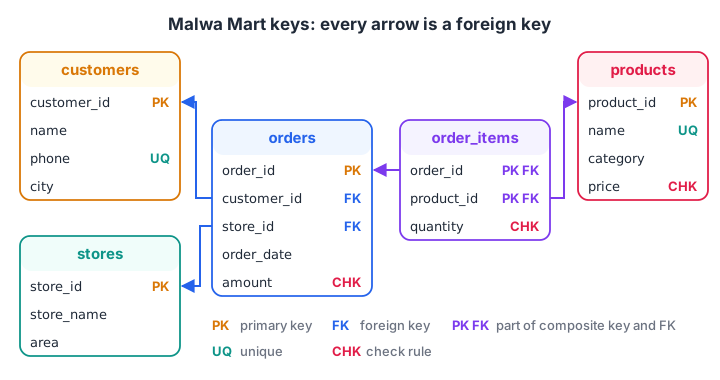
Arrows run from each foreign key to the primary key it references. order_items has a two-column primary key, and each part is also a foreign key.
Foreign keys make SQL joins trustworthy: if every order has a real customer, an INNER JOIN never silently drops an order.
Watching the database reject bad data
The block below builds the products and order_items tables with constraints, adds order 101's four lines, and then tries six bad inserts. Each one breaks a different rule.
import sqlite3

con = sqlite3.connect(":memory:")
con.execute("PRAGMA foreign_keys = ON")          # SQLite needs this on every connection
con.executescript("""
CREATE TABLE products (product_id INTEGER PRIMARY KEY, product_name TEXT NOT NULL UNIQUE,
    category TEXT NOT NULL, price INTEGER NOT NULL CONSTRAINT price_positive CHECK (price > 0));
CREATE TABLE order_items (order_id INTEGER NOT NULL,
    product_id INTEGER NOT NULL REFERENCES products(product_id),
    quantity INTEGER NOT NULL CHECK (quantity > 0), PRIMARY KEY (order_id, product_id));
INSERT INTO products VALUES (1,'Basmati Rice 5kg','Grocery',520), (3,'Poha 1kg','Grocery',60),
 (7,'Detergent 2kg','Household',340), (8,'Sev 500g','Snacks',120);
INSERT INTO order_items VALUES (101,1,1), (101,7,1), (101,8,1), (101,3,1);
""")
attempts = {
    "rice twice on bill 101":  "INSERT INTO order_items VALUES (101, 1, 2)",
    "product 2 not in table":  "INSERT INTO order_items VALUES (102, 2, 2)",
    "zero quantity":           "INSERT INTO order_items VALUES (104, 3, 0)",
    "duplicate product name":  "INSERT INTO products VALUES (9, 'Sev 500g', 'Snacks', 120)",
    "free sample at price 0":  "INSERT INTO products VALUES (9, 'Free sample', 'Promo', 0)",
    "no category given":       "INSERT INTO products (product_id, product_name, price) VALUES (9, 'Ghee 1L', 650)",
}
for label, sql in attempts.items():
    try:
        con.execute(sql)
        print(f"accepted  {label}")
    except sqlite3.IntegrityError as err:
        print(f"rejected  {label:24} -> {err}")
All six are rejected, and each message names the rule that failed. The named constraint price_positive appears by name, which is why teams name their CHECKs. Product 2 (Toor Dal) was left out on purpose, so the foreign key catches it.
What happens to child rows on DELETE?
A foreign key also decides what happens when someone deletes a parent row that children still point to. You choose the behaviour with ON DELETE (and similarly ON UPDATE).
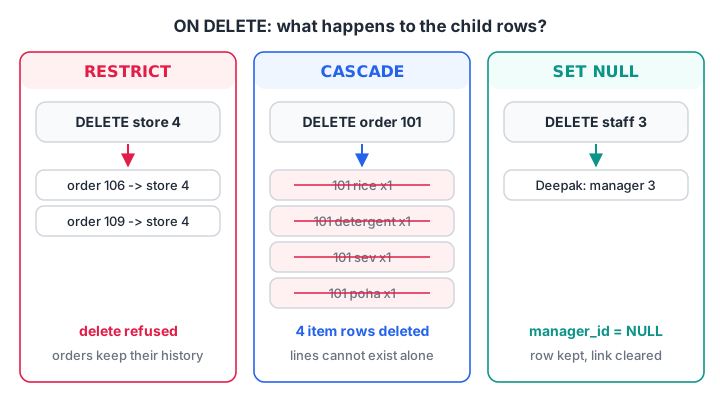
RESTRICT protects history, CASCADE removes rows that make no sense alone, and SET NULL keeps the child but forgets the link.
| Option | What happens to child rows | Good for |
|---|---|---|
NO ACTION / RESTRICT |
The delete is refused | Orders that point to a store |
CASCADE |
Child rows are deleted too | Bill lines that point to an order |
SET NULL |
The foreign key becomes NULL | Staff whose manager has left |
SET DEFAULT |
The foreign key takes its default | Rare; needs a valid default row |
NO ACTION is the default. It differs from RESTRICT only in timing: NO ACTION may be checked at the end of a statement or transaction, RESTRICT immediately.
The block below uses the staff table from the self join article, where manager_id points back into the same table.
import sqlite3

con = sqlite3.connect(":memory:")
con.execute("PRAGMA foreign_keys = ON")
con.executescript("""
CREATE TABLE stores (store_id INTEGER PRIMARY KEY, store_name TEXT);
CREATE TABLE orders (order_id INTEGER PRIMARY KEY, store_id INTEGER REFERENCES stores(store_id) ON DELETE RESTRICT);
CREATE TABLE order_items (order_id INTEGER REFERENCES orders(order_id) ON DELETE CASCADE,
                          product_id INTEGER, quantity INTEGER, PRIMARY KEY (order_id, product_id));
CREATE TABLE staff (staff_id INTEGER PRIMARY KEY, name TEXT,
                    manager_id INTEGER REFERENCES staff(staff_id) ON DELETE SET NULL);
INSERT INTO stores VALUES (1,'Malwa Mart Vijay Nagar'), (4,'Malwa Mart Bhawarkuan');
INSERT INTO orders VALUES (101,1), (106,4), (109,4);
INSERT INTO order_items VALUES (101,1,1), (101,7,1), (101,8,1), (101,3,1), (106,8,1), (109,7,1);
INSERT INTO staff VALUES (1,'Rajesh Sharma',NULL), (3,'Arjun Malviya',1), (5,'Deepak Yadav',3);
""")
try:
    con.execute("DELETE FROM stores WHERE store_id = 4")
except sqlite3.IntegrityError as err:
    print("RESTRICT: store 4 not deleted ->", err)

con.execute("DELETE FROM orders WHERE order_id = 101")
print("CASCADE : items left =", con.execute("SELECT COUNT(*) FROM order_items").fetchone()[0], "(was 6)")

con.execute("DELETE FROM staff WHERE staff_id = 3")
print("SET NULL:", con.execute("SELECT name, manager_id FROM staff WHERE staff_id = 5").fetchone())
Bhawarkuan cannot be deleted while orders 106 and 109 point to it. Deleting order 101 takes its four bill lines with it. When Arjun Malviya leaves, Deepak Yadav stays on with no manager until one is assigned.
Quick check
order_items has FOREIGN KEY (order_id) REFERENCES orders ON DELETE CASCADE. What happens when you delete order 101?
CASCADE deletes child rows along with the parent. RESTRICT would refuse, and SET NULL would clear the column.
Constraint differences in SQLite, MySQL and PostgreSQL
- Foreign keys in SQLite are off by default. Run
PRAGMA foreign_keys = ONon every new connection, or they are silently ignored. MySQL's InnoDB engine and PostgreSQL always enforce them. - CHECK in MySQL. MySQL parsed CHECK constraints but ignored them before version 8.0.16. On older servers, a CHECK gives you no protection.
- NULL in a SQLite primary key. Because of a long-standing quirk, SQLite allows NULL in a non-integer primary key column unless you also write NOT NULL or use a STRICT or WITHOUT ROWID table.
- Adding constraints later. MySQL and PostgreSQL support
ALTER TABLE orders ADD CONSTRAINT fk_customer FOREIGN KEY (customer_id) REFERENCES customers(customer_id). SQLite cannot add constraints to an existing table; you rebuild the table, as the CREATE TABLE article shows.
Before adding a foreign key to old data, look for orphans: child rows whose parent is missing. A LEFT JOIN with WHERE parent.id IS NULL finds them, and SQLite also offers PRAGMA foreign_key_check.
import sqlite3

con = sqlite3.connect(":memory:")
con.executescript("""
CREATE TABLE customers (customer_id INTEGER PRIMARY KEY, name TEXT);
CREATE TABLE orders (order_id INTEGER PRIMARY KEY, customer_id INTEGER REFERENCES customers(customer_id));
INSERT INTO customers VALUES (1,'Asha Verma'), (2,'Ravi Patel'), (3,'Meera Joshi');
INSERT INTO orders VALUES (101,1), (102,2), (104,3), (190,99), (191,42);   -- two legacy orphans
""")
orphans = con.execute("""
    SELECT o.order_id, o.customer_id FROM orders o
    LEFT JOIN customers c ON c.customer_id = o.customer_id
    WHERE c.customer_id IS NULL""").fetchall()
print("orphans via LEFT JOIN:", orphans)
print("PRAGMA foreign_key_check:", con.execute("PRAGMA foreign_key_check").fetchall())
Orders 190 and 191 point to missing customers. Fix or remove them first, or MySQL and PostgreSQL will refuse to create the constraint.
Common mistakes with SQL constraints and keys
- No primary key at all. Duplicate rows creep in and you cannot target a single row safely.
- Using a changeable value as the primary key. Phone numbers and email addresses change; put them under UNIQUE instead.
- Forgetting PRAGMA foreign_keys in SQLite. The schema looks safe, but nothing is checked.
- Cascading deletes on business history. Deleting one customer should not erase a year of sales.
- Validating only in the app. A second app, a script or a bulk import will bypass it. Constraints protect the data no matter who writes it.
Interviewers often ask candidates to sketch a schema. To practise that with feedback, database design lessons in Debugshala's analytics course build schemas like this one, and database design quizzes on Debugshala Test are a quick revision. Next, database normalisation explains how to decide which tables you need in the first place.
Key takeaways
- Constraints move data rules into the database, where every app and script must obey them.
- A primary key is unique and not NULL; use a surrogate key and protect natural keys with UNIQUE.
- A composite primary key such as (order_id, product_id) identifies rows by a combination of columns.
- A foreign key guarantees that a referenced row exists; ON DELETE decides what happens to children.
- In SQLite, turn on PRAGMA foreign_keys and remember you cannot add constraints with ALTER TABLE.
FAQ
What is the difference between a primary key and a foreign key?
A primary key uniquely identifies each row in its own table and cannot be NULL. A foreign key is a column in another table that stores those primary key values to link rows together. For example, customers.customer_id is a primary key, and orders.customer_id is a foreign key pointing to it.
Can a table have two primary keys?
No. A table has at most one primary key, but that key can include several columns, which is called a composite primary key, such as PRIMARY KEY (order_id, product_id). If you need other columns to be unique as well, add UNIQUE constraints to them. A table can have many UNIQUE constraints.
Can a foreign key be NULL?
Yes, unless you also declare it NOT NULL. A NULL foreign key means "no related row", such as a staff member with no manager. The database only checks foreign key values that are not NULL. Use NOT NULL when every child row must have a parent, as every order must have a store.
What is the difference between UNIQUE and PRIMARY KEY?
Both stop duplicate values. A primary key also forbids NULL, and a table can have only one. UNIQUE allows NULLs in most databases and can appear on many columns. Use the primary key to identify rows, and UNIQUE for other values that must not repeat, such as phone numbers or product names.
Where can I learn database design and SQL keys in Indore?
Debugshala, an IT training and placement institute at Old Palasia, Indore, teaches keys, constraints and schema design within its Data Analytics course. Classes are offline in English and Hindi, fresh graduates, non-IT students and people with a year gap can join, and you can sit a free demo class before enrolling.
From the team behind this site
Go further with the Data Analytics Course at Debugshala
These tutorials are written by Debugshala, a training and placement institute at Old Palasia, Indore. The classroom course adds live mentoring, real projects and interview preparation.
- Offline classes at Old Palasia, Indore
- Free demo class before you pay
- Non-IT, fresher and year-gap friendly
- Placement assistance
700+ students placed · 200+ hiring partners · 4.9★ Google rating
