

GST Returns Explained: GSTR-1, GSTR-3B, GSTR-2B and Due Dates
GSTR-1, GSTR-1A, GSTR-2B and GSTR-3B explained with due dates, IMS, late fees, a worked ITC set-off example and monthly reconciliation steps in TallyPrime.
Imagine a cricket scorer at the Holkar Stadium. Every ball goes into the scorebook, and after each innings the scorer sends the board a summary. If the summary doesn't match the ball-by-ball book, someone gets a phone call.
GST returns work the same way. Your Tally vouchers are the ball-by-ball book. GSTR-1 sends the detailed sales list to the portal. GSTR-3B is the innings summary: tax owed, credit claimed and tax paid. If the two don't match, the system notices.
GST returns are the periodic statements a registered business files on the GST portal to report its sales, claim input tax credit and pay the GST due for each tax period.
This covers a regular taxpayer's monthly and quarterly returns, as of November 2026. New to CGST, SGST and ITC? Read GST basics in India first.
Which GST returns does a regular business file?
| Return | What it is | Who prepares it | Monthly due date | Quarterly (QRMP) due date |
|---|---|---|---|---|
| GSTR-1 | Statement of outward supplies (sales), invoice by invoice | You | 11th of next month | 13th of the month after the quarter |
| IFF | Optional B2B sales upload for months 1 and 2 of a quarter | You (QRMP only) | – | 13th of the next month |
| GSTR-1A | Optional amendment to that period's GSTR-1 | You | Before filing GSTR-3B | Before filing GSTR-3B |
| GSTR-2B | Statement of input tax credit available, built from suppliers' filings | GST system | Generated on the 14th | GSTR-2BQ on the 14th after the quarter |
| GSTR-3B | Summary return: tax liability, ITC claimed, tax paid | You | 20th of next month | 22nd or 24th after the quarter, by state |
| GSTR-9 | Annual return | You | Yearly | Yearly |
The government can extend dates by notification, so check the GST portal's due-date list.
What is the QRMP scheme?
The Quarterly Return Monthly Payment (QRMP) scheme lets businesses with aggregate turnover up to ₹5 crore file GSTR-1 and GSTR-3B quarterly while paying tax monthly. In months 1 and 2 they can use the IFF so B2B buyers get credit on time.
Quarterly GSTR-3B is due on the 22nd or 24th depending on the state. Madhya Pradesh is in the 22nd group with Gujarat, Maharashtra and Chhattisgarh; most northern, eastern and north-eastern states, including Delhi, file by the 24th.
Quick check
A monthly filer's October GSTR-1 is due on which date?
Monthly GSTR-1 is due on the 11th of the following month. GSTR-2B is generated on the 14th and GSTR-3B is due on the 20th.
Quick check
You find a wrong invoice amount in a filed GSTR-1 and GSTR-3B is not filed yet. What should you do?
GSTR-1A corrects GSTR-1 for the same period, and the corrected liability flows into GSTR-3B.
What is GSTR-1 and what goes into it?
GSTR-1 lists everything you sold in the period. Your buyers' ITC depends on it, so a late or wrong GSTR-1 hurts them too. Its main sections:
- B2B: invoice-wise details of supplies to registered buyers, with their GSTIN.
- B2C (Large): inter-state supplies to unregistered buyers where the invoice value is more than ₹1,00,000 (lowered from ₹2,50,000 from 1 August 2024), reported invoice by invoice.
- B2C (Small): all other supplies to unregistered buyers, reported as summaries by state and rate.
- Exports, including supplies to SEZs.
- Credit and debit notes issued against earlier invoices.
- Nil-rated, exempt and non-GST supplies.
- HSN summary: sales grouped by HSN/SAC. From May 2025 it is split into separate B2B and B2C tables.
What is GSTR-1A?
GSTR-1A is an optional amendment to a filed GSTR-1. It opens after GSTR-1 is filed (or its due date, whichever is later), can be filed once per period, and must come before that period's GSTR-3B. Its changes flow into your GSTR-3B and into the buyer's next GSTR-2B.
What is GSTR-2B and how is it used?
GSTR-2B is a read-only statement built from your suppliers' GSTR-1, IFF and GSTR-1A, showing invoice by invoice which ITC is available. Monthly filers get it on the 14th. Since October 2024, invoices first land in the Invoice Management System (IMS), where you act on each:
- Accept: the credit goes into the "ITC Available" part of GSTR-2B.
- Reject: it goes into "ITC Rejected" and does not reach GSTR-3B.
- Pending: it stays out of this month's GSTR-2B and waits on the IMS dashboard.
- No action: treated as accepted when GSTR-2B is generated.
You can change an action until that period's GSTR-3B is filed (then recompute GSTR-2B). The draft GSTR-2B isn't generated on the 14th if your previous GSTR-3B is unfiled.
Quick check
In IMS, what happens to an invoice you leave with no action?
No action means deemed acceptance at the time GSTR-2B is generated.
What is GSTR-3B and how do you fill it?
GSTR-3B is where money changes hands: output tax, ITC and net payment. All normal taxpayers file it, even with no business (a nil return).
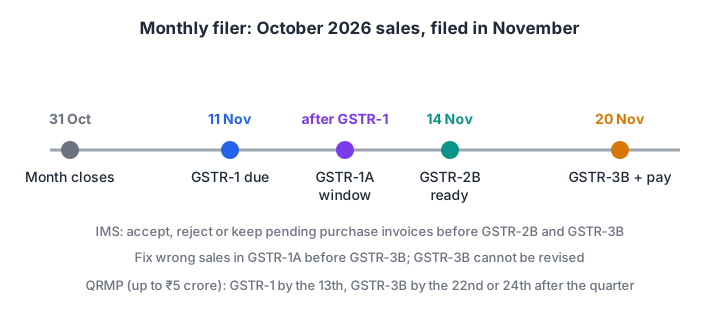
A monthly filer's cycle for October 2026 sales: details out by 11 November, credit statement on 14 November, summary and payment by 20 November.
Key parts of GSTR-3B:
- Table 3.1: outward supplies and tax on them, plus inward supplies liable to reverse charge.
- Table 3.2: inter-state supplies to unregistered persons, composition dealers and UIN holders, auto-filled from GSTR-1/1A.
- Table 4: input tax credit, auto-filled from GSTR-2B, with reversals.
- Table 6.1: payment of tax, by cash and by credit.
Two rules make GSTR-3B strict. First, once filed it cannot be revised; you correct mistakes in a later period. Second, GSTN is locking the auto-filled figures. An advisory of 7 June 2025 said the liability auto-filled from GSTR-1, GSTR-1A or IFF would become non-editable from the July 2025 tax period, and Table 3.2 has been non-editable since the November 2025 tax period.
The portal's GSTR-3B FAQ still describes auto-filled values as editable with a red warning, so check what your screen allows. Either way, if a sale was reported wrongly, fix it through GSTR-1A before filing GSTR-3B.
Worked example: Narmada Traders, October 2026
Narmada Traders, a monthly filer in Indore, has these totals for October 2026:
| Item | IGST (₹) | CGST (₹) | SGST (₹) |
|---|---|---|---|
| Output tax on sales (from GSTR-1) | 9,000 | 13,500 | 13,500 |
| ITC available (from GSTR-2B) | 21,600 | 1,800 | 1,800 |
IGST credit first pays IGST (₹9,000 of ₹21,600). The remaining ₹12,600 can pay CGST and SGST in any order: ₹11,700 to CGST and ₹900 to SGST. Then own CGST and SGST credit (₹1,800 each) are applied.
| IGST | CGST | SGST | |
|---|---|---|---|
| Liability | 9,000 | 13,500 | 13,500 |
| Paid by IGST credit | 9,000 | 11,700 | 900 |
| Paid by own credit | – | 1,800 | 1,800 |
| Paid in cash | 0 | 0 | 10,800 |
Total liability ₹36,000, total credit ₹25,200, cash ₹10,800. This split leaves no credit unused. A careless split, such as putting all the leftover IGST credit on SGST, would strand ₹900 of SGST credit and raise the cash payment to ₹11,700.
What happens if you file late?
- Late fee on GSTR-3B: ₹25 per day under CGST plus ₹25 under SGST (₹50 a day in total) when there is tax to pay, or ₹10 + ₹10 (₹20 a day) for a nil return, subject to maximum caps that depend on turnover.
- Interest: on tax paid late, under section 50 of the CGST Act, at the notified rate of 18% a year, charged on the portion paid in cash.
- Time bar: under amendments to the CGST Act (in force from 1 October 2023), GSTR-1, GSTR-1A, GSTR-3B, GSTR-9 and several other returns cannot be filed once three years have passed from their due date. The portal enforces this: from 1 December 2025, for example, GSTR-3B for October 2022 can no longer be filed.
The 57th GST Council (8 October 2026) recommended waiving late fees for turnover up to ₹5 crore if the return is filed by the end of its due month. It needs a notification first.
How do you reconcile GST returns with your books?
Make reconciliation a monthly habit. Run three checks before filing GSTR-3B:
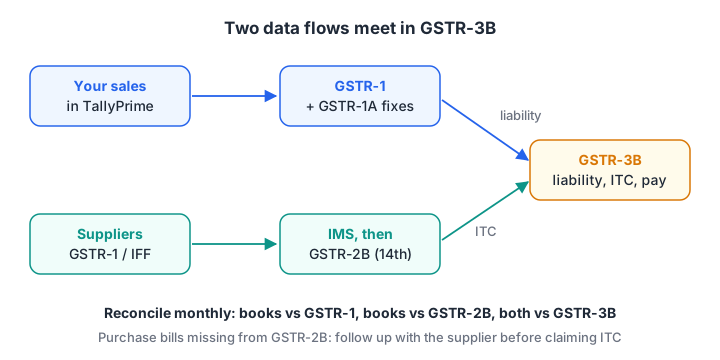
Sales flow from books to GSTR-1 and on to GSTR-3B; purchases flow from suppliers through IMS and GSTR-2B to the ITC in GSTR-3B.
- Books vs GSTR-1. The sales register total, tax by rate and HSN summary should match what you are reporting.
- Books vs GSTR-2B. Match every purchase bill with GSTR-2B. Bills in your books but missing from GSTR-2B mean the supplier hasn't reported them; follow up before claiming. Entries only on the portal may be bills you forgot to record.
- GSTR-1 and GSTR-2B vs GSTR-3B. Liability should equal GSTR-1 (plus GSTR-1A), and ITC should not exceed GSTR-2B after reversals.
In TallyPrime, GSTR-1 and GSTR-3B sit under Gateway of Tally > Display More Reports > GST Reports (or Alt+G and the name); F5 switches between Return View (as on the portal) and Nature View (as in your books).
Download GSTR-2B and open GSTR-2B Reconciliation with Alt+G to see matched, mismatched and portal-only invoices. Tally's FAQ says TallyPrime doesn't currently file GSTR-1A, so do that on the portal. Clean masters from the GST setup article keep these reports accurate. Debugshala teaches TallyPrime, including these GST reports, at its Old Palasia campus.
Many accountants export both sides to Excel and match them with lookups. A good grip on Excel for data analysis makes that job much faster.
Common mistakes in GST return filing
- Filing GSTR-3B before fixing GSTR-1. Once the liability is locked, the only clean fix is GSTR-1A before GSTR-3B.
- Claiming credit beyond GSTR-2B. It leads to notices and interest.
- Ignoring IMS. Pending invoices don't reach GSTR-2B, so credit gets delayed if nobody acts.
- Missing a nil return. No business still means filing, or the late fee applies.
You can test your understanding of these dates with quick quizzes on Debugshala Test.
Key takeaways
- GSTR-1 reports sales (11th monthly, 13th after the quarter); GSTR-3B summarises and pays tax (20th monthly, 22nd or 24th after the quarter).
- GSTR-2B, generated on the 14th, decides how much ITC you can claim, and IMS lets you accept, reject or hold invoices first.
- Fix GSTR-1 errors through GSTR-1A before filing GSTR-3B, because GSTR-3B can't be revised and GSTN is locking its auto-filled liability.
- Reconcile books with GSTR-1, GSTR-2B and GSTR-3B every month.
FAQ
What is the difference between GSTR-1 and GSTR-3B?
GSTR-1 is a detailed statement of your sales, invoice by invoice, that also passes credit to your buyers. GSTR-3B is a summary return where you declare total tax liability, claim input tax credit and pay the balance. GSTR-1 is filed first, and its figures flow into GSTR-3B.
What is the due date of GSTR-3B?
For monthly filers, GSTR-3B is due on the 20th of the following month. For quarterly filers under QRMP, it is due on the 22nd or 24th of the month after the quarter, depending on the state. Madhya Pradesh businesses fall in the 22nd group. The government can extend dates by notification.
What is the late fee for GSTR-3B?
The late fee is ₹50 per day (₹25 CGST + ₹25 SGST) if you have tax to pay, and ₹20 per day (₹10 + ₹10) for a nil return, subject to turnover-based maximum caps. Interest at the notified rate of 18% a year also applies on tax paid late in cash.
Where can I practise GST returns in Tally in Indore?
Debugshala teaches TallyPrime at its Old Palasia campus in Indore, and preparing GST reports such as GSTR-1 and GSTR-3B in Tally is part of learning the software. Courses accept fresh graduates and people with a year gap, and there is a free demo class. You can check Tally batch timings with Debugshala.
Sources
- FAQs on Form GSTR-1, GST Portal user guide (accessed November 2026)
- FAQs on Form GSTR-3B, GST Portal user guide (accessed November 2026)
- How can I create, save, pay taxes and file Form GSTR-3B, GST Portal user guide (accessed November 2026)
- FAQs on Viewing Form GSTR-2B, GST Portal user guide (accessed November 2026)
- FAQs on Invoice Management System (IMS), GSTN (22 September 2024)
- Invoice Furnishing Facility (IFF) FAQ, GST Portal user guide (accessed November 2026)
- QRMP: staggered GSTR-3B due dates by state, GST Portal news (2021)
- Advisory regarding non-editable of auto-populated liability in GSTR-3B, GSTN (7 June 2025)
- Advisory on reporting values in Table 3.2 of GSTR-3B, GSTN (5 December 2025)
- Advisory to file pending returns before expiry of three years, GSTN (29 October 2025)
- Section 50, CGST Act 2017: Interest on delayed payment of tax, CBIC (accessed November 2026)
- Goods and Services Tax Rate and Policy (late fee per day), PIB (2018)
- Next-Gen GST Process Reforms (57th GST Council), PIB (9 October 2026)
- How to View GSTR-3B Report in TallyPrime and GSTR-1 FAQ, TallyHelp, Tally Solutions (accessed November 2026)
- B2C (Large) Invoices in GSTR-1, TallyHelp, Tally Solutions (accessed November 2026)
- How to Reconcile GSTR-2B Data in TallyPrime, TallyHelp, Tally Solutions (accessed November 2026)
From the team behind this site
Go further with the Data Analytics Course at Debugshala
These tutorials are written by Debugshala, a training and placement institute at Old Palasia, Indore. The classroom course adds live mentoring, real projects and interview preparation.
- Offline classes at Old Palasia, Indore
- Free demo class before you pay
- Non-IT, fresher and year-gap friendly
- Placement assistance
700+ students placed · 200+ hiring partners · 4.9★ Google rating
