

GST Basics in India: CGST, SGST, IGST and Input Tax Credit
Learn GST basics in India: CGST, SGST and IGST with ₹ examples, the 5% and 18% rates since September 2025, input tax credit rules and registration limits.
Imagine you run Narmada Traders, the made-up Indore wholesaler from the Tally Basics articles. Besides pulses and spices, you now stock mixer grinders, bought from a factory in Pune and sold to retailers in Bhopal and Ahmedabad. On every bill you pay some tax, and on every sale you collect some.
Before 2017, a trader like you juggled VAT, central sales tax, excise and entry tax, and tax was often charged on tax. GST replaced that patchwork with one tax. You still pay tax when you buy and collect it when you sell, but you pay the government only the difference.
GST (Goods and Services Tax) is a destination-based tax on the supply of goods and services in India, collected at every stage of the supply chain, with credit for tax paid at earlier stages.
The rules here are as of November 2026, from the government sources listed at the end.
What is GST and how does it work in India?
GST came into force on 1 July 2017. According to a PIB note from June 2026, it subsumed 17 central and state taxes and 13 cesses into one framework. Alcoholic liquor for human consumption stays outside GST.
Three ideas make GST work:
- Tax on supply. GST is charged when goods or services are supplied, not separately on manufacture, sale or service.
- Destination-based. The tax goes to the state where the goods or services are finally consumed.
- Credit at every stage. Each registered business claims credit for the GST it paid on inputs, so the final tax equals the rate on the price the consumer pays.
The GST Council (the Union and state finance ministers) recommends rates and rules. The GST Network (GSTN) runs the portal at gst.gov.in where businesses register and file returns.
What are CGST, SGST, UTGST and IGST?
Both the Centre and the states take a share of GST, so it has a dual structure.
| Component | Full name | Charged on | Goes to |
|---|---|---|---|
| CGST | Central GST | Supplies within one state | Central government |
| SGST | State GST | Supplies within one state | That state government |
| UTGST | Union Territory GST | Supplies within a UT without a legislature, such as Ladakh | That UT |
| IGST | Integrated GST | Supplies from one state to another, imports and exports | Centre, which settles the states' share |
The rule of thumb is simple. If the supplier and the place of supply are in the same state, charge CGST + SGST, each at half the rate. If they are in different states, charge IGST at the full rate. IGST rates are generally twice the CGST or SGST rate.
What is place of supply?
The place of supply decides whether a sale is intra-state or inter-state. For goods that are moved, it is usually where the movement ends. For most services sold to a registered business, it is generally the buyer's location. So Indore to Bhopal is intra-state; Indore to Ahmedabad is inter-state.
Worked example: an Indore trader selling in MP and to Gujarat
Narmada Traders sells mixer grinders worth ₹50,000 (before tax). Assume they are taxed at 18%; in real work you would confirm the rate for the item's HSN code.
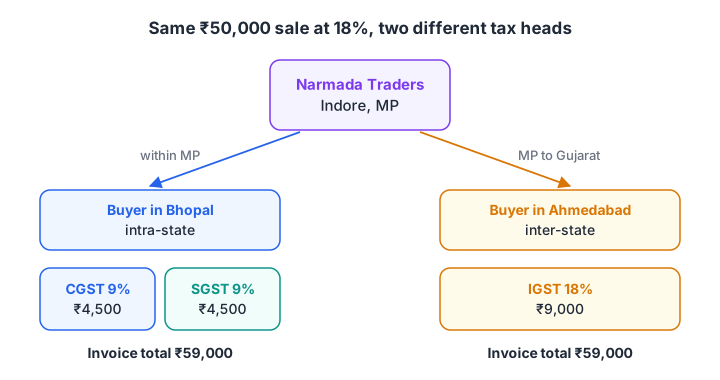
The same ₹50,000 sale at 18%: split into CGST and SGST inside Madhya Pradesh, charged as IGST when the goods go to Gujarat.
| Sale to Bhopal (intra-state) | Sale to Ahmedabad (inter-state) | |
|---|---|---|
| Taxable value | ₹50,000 | ₹50,000 |
| CGST @ 9% | ₹4,500 | – |
| SGST @ 9% | ₹4,500 | – |
| IGST @ 18% | – | ₹9,000 |
| Invoice total | ₹59,000 | ₹59,000 |
The buyer pays the same total either way. What changes is which government gets the tax, and which ledgers you select in Tally. If Tally itself is new, read what TallyPrime is and the voucher entry guide first.
Quick check
An Indore shop sells goods to a customer in Ujjain. Which tax does it charge?
Indore and Ujjain are both in Madhya Pradesh, so the sale is intra-state and attracts CGST and SGST.
What are the GST rates after the September 2025 changes?
The 56th GST Council meeting on 3 September 2025 recommended replacing the old four-slab structure (5%, 12%, 18%, 28%) with a simpler one. The changes took effect on 22 September 2025, and the government calls them the Next-Gen GST reforms or "GST 2.0".
| Rate | Who it applies to |
|---|---|
| 0% (nil or exempt) | Many staple foods and essentials, and some services such as individual health and life insurance |
| 5% (merit rate) | Most everyday goods and services; many items moved here from 12% |
| 18% (standard rate) | Most other goods and services; many items moved here from 28% |
| 40% (special rate) | A short list of luxury and sin goods, such as high-end cars, aerated drinks, yachts and private aircraft |
A few examples announced by PIB: hotel rooms up to ₹7,500 a day moved from 12% to 5%; small cars and motorcycles up to 350cc moved from 28% to 18%; and gym, salon and yoga services moved from 18% to 5%. Tobacco products followed a separate timeline linked to the compensation cess.
Quick check
What are the main GST rates on goods and services after 22 September 2025?
The 56th GST Council moved to two main rates, 5% and 18%, plus a special 40% rate for a short list of items.
What is Input Tax Credit (ITC)?
Input Tax Credit is the GST a registered business paid on its purchases, which it can subtract from the GST it collects on its sales. Without ITC, tax would pile up at every stage and the consumer would pay tax on tax.
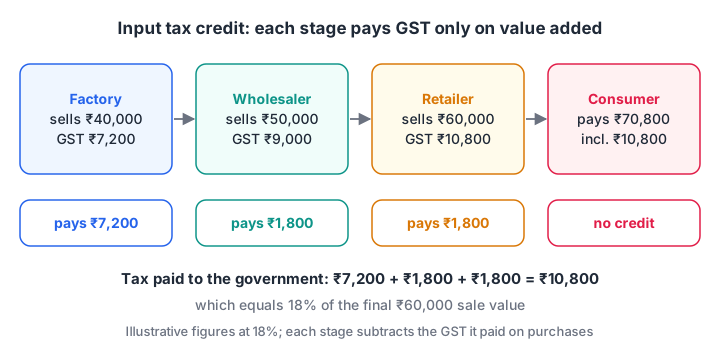
Each business in the chain pays only the GST on the value it adds; the credit from the previous stage covers the rest.
Take Narmada Traders again. This month it buys mixer grinders worth ₹40,000 from the Pune factory and pays IGST of ₹7,200 (18%). It sells them in Bhopal for ₹50,000 and collects CGST ₹4,500 + SGST ₹4,500 = ₹9,000.
| Step | Amount |
|---|---|
| GST collected on sales (output tax) | ₹9,000 |
| GST paid on purchases (input tax credit) | ₹7,200 |
| Net GST payable in cash | ₹1,800 |
How is IGST credit used against CGST and SGST?
IGST credit is used first against IGST liability; what is left can pay CGST or SGST in any order. Here there is no IGST liability, so ₹4,500 of the credit can clear CGST and ₹2,700 goes to SGST, leaving ₹1,800 SGST to pay in cash. CGST credit can never pay SGST, or the reverse.
When can you claim ITC?
Section 16 of the CGST Act sets the conditions. You can claim ITC only when all of these hold:
- You hold a tax invoice or debit note from a registered supplier.
- The invoice appears in your GSTR-2B, the auto-drafted credit statement built from what suppliers report.
- You have actually received the goods or services.
- The supplier has paid the tax to the government.
- You have filed your own GSTR-3B return.
Two more rules trip up beginners. You must pay the supplier within 180 days of the invoice date, or reverse the credit until you pay. And you cannot claim credit for an invoice after 30 November following the end of that financial year, or after you file the annual return, whichever is earlier.
Some purchases never give credit, such as goods for personal use and items blocked under section 17(5). The 57th GST Council (8 October 2026) recommended removing some blocks, such as those on outdoor catering, health and life insurance and free samples, but check they are notified before relying on that.
Quick check
A trader has ₹6,000 IGST credit and owes ₹3,000 CGST and ₹3,000 SGST, with no IGST liability. How much must it pay in cash?
Leftover IGST credit can be used against CGST and SGST, so the ₹6,000 credit covers both.
Who must register for GST?
Registration is required once your aggregate turnover in a financial year crosses the threshold. As of November 2026:
| Supplier type | Threshold in most states (including MP) |
|---|---|
| Only goods | ₹40 lakh |
| Services, or goods and services | ₹20 lakh |
Some special category states have lower limits. Some businesses must register whatever their turnover, such as anyone making inter-state taxable supplies of goods. Businesses with turnover up to ₹1.5 crore in most states can opt for the composition scheme: a fixed rate on turnover, but no GST collected from buyers and no ITC.
Every registered person gets a 15-character GSTIN: a two-digit state code, the business's 10-character PAN, an entity number, the letter Z by default and a check character. Madhya Pradesh GSTINs start with 23.
Common GST mistakes beginners make
- Charging IGST on a local sale. If the goods stay inside the state, it is CGST + SGST; fixing a wrong tax head means paying the right one and claiming a refund.
- Claiming ITC that is not in GSTR-2B. If your supplier didn't report the invoice, you generally can't claim it yet. Chase the supplier first.
- Using an old slab chart. The 12% and 28% slabs no longer exist for most goods since 22 September 2025.
- Forgetting the 180-day payment rule. Credit taken on an unpaid bill has to be reversed.
To check you have the CGST, SGST and IGST logic straight, practise quick quizzes on Debugshala Test. Next, set up GST in TallyPrime to build these invoices, then see how they reach GSTR-1 and GSTR-3B.
Key takeaways
- GST is one destination-based tax on supply, with credit at every stage.
- Intra-state sales attract CGST + SGST (half each); inter-state sales attract IGST at the full rate.
- Since 22 September 2025 the main rates are 5% and 18%, with 40% for select luxury and sin goods; always check the HSN-wise rate.
- ITC needs a valid invoice that shows in GSTR-2B, goods received, tax paid by the supplier and your own return filed.
- Most goods-only suppliers register at ₹40 lakh turnover, and service providers at ₹20 lakh.
FAQ
What is the difference between CGST, SGST and IGST?
CGST and SGST are charged together on a sale within one state, each at half the GST rate, with one share going to the Centre and one to the state. IGST is charged on a sale from one state to another at the full rate, and the Centre later settles the destination state's share.
What are the new GST slabs in India?
From 22 September 2025, most goods and services fall in two slabs, 5% and 18%. A special 40% rate applies to a short list of luxury and sin goods such as high-end cars and aerated drinks. Many essentials are nil-rated or exempt. Check the exact rate for each HSN code on official sources.
Is GST registration compulsory for small businesses?
Not always. A business supplying only goods needs to register once turnover crosses ₹40 lakh in most states, and a service business at ₹20 lakh. Some businesses must register regardless of turnover, such as those making inter-state taxable supplies of goods. Voluntary registration is allowed and lets you claim input tax credit.
Can I claim ITC if my supplier has not filed GSTR-1?
Generally no. Your credit must appear in your GSTR-2B, which is built from what your suppliers report in GSTR-1 or IFF. If an invoice is missing, ask the supplier to report it; the credit then shows in a later GSTR-2B, and you can claim it within the section 16(4) time limit.
Where can I learn GST accounting in Tally in Indore?
Debugshala teaches TallyPrime at its Old Palasia campus in Indore, and recording GST invoices is part of learning Tally properly. Classes run in English and Hindi, fresh graduates and learners from non-IT backgrounds are accepted, and there is a free demo class first. You can enquire about TallyPrime classes at Debugshala.
Sources
- Nine Years of GST: Simplifying Taxation, Strengthening India, PIB (30 June 2026)
- Recommendations of the 56th Meeting of the GST Council, PIB, Ministry of Finance (3 September 2025)
- GST Reforms 2025: Relief for Common Man, Boost for Businesses, PIB (September 2025)
- Next-Gen GST Process Reforms (57th GST Council), PIB (9 October 2026)
- Recommendations of the 57th GST Council Meeting: Key Reforms, GSTN (9 October 2026)
- Section 16, CGST Act 2017: Eligibility and conditions for taking input tax credit, CBIC (accessed November 2026)
- How can I create, save, pay taxes and file Form GSTR-3B, GST Portal user guide (accessed November 2026)
- GST: An Update (registration thresholds from 1 April 2019), CBIC (May 2019)
From the team behind this site
Go further with the Data Analytics Course at Debugshala
These tutorials are written by Debugshala, a training and placement institute at Old Palasia, Indore. The classroom course adds live mentoring, real projects and interview preparation.
- Offline classes at Old Palasia, Indore
- Free demo class before you pay
- Non-IT, fresher and year-gap friendly
- Placement assistance
700+ students placed · 200+ hiring partners · 4.9★ Google rating
